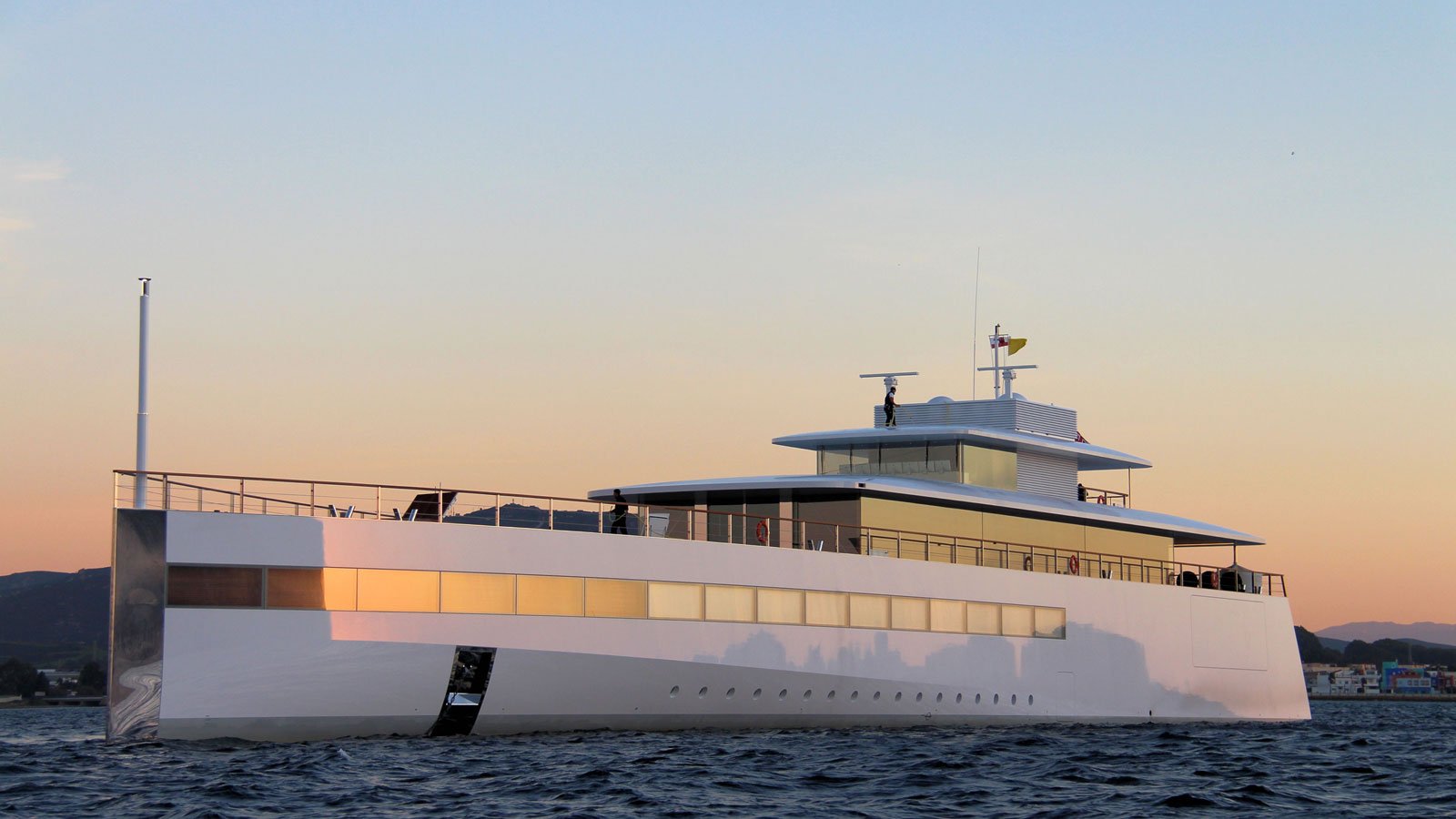
Have you ever wondered what happens when one of the greatest innovators of our time applies his design philosophy to a floating masterpiece? The iconic Steve Jobs yacht, named Venus after the Roman goddess of love, stands as a testament to minimalism, precision, and forward-thinking elegance. Let’s explore its fascinating story in depth.
The Origins: A Vision from Summer Vacations
Launched in 2012, and tragically one year after Jobs’ passing in October 2011, this Feadship-built superyacht continues to captivate yacht enthusiasts worldwide. Moreover, as we approach the end of 2025, Venus remains privately owned by Laurene Powell Jobs and rarely charters, preserving its aura of mystery.
The journey of the Steve Jobs yacht began around 2008, inspired by family summers aboard Oracle founder Larry Ellison’s yachts.
Jobs, battling pancreatic cancer at the time, envisioned a vessel that embodied Apple’s core principles: simplicity, functionality, and beauty without excess.
He personally collaborated with renowned French designer Philippe Starck, whose firm Ubik handled both exterior and interior concepts.
Transitioning from tech to maritime design, Jobs reportedly flew to Starck’s studio monthly for intense sessions. Starck later recalled Jobs saying the project was “beyond all my dreams,” despite his reputation for uncompromising demands.
Furthermore, Apple’s former design chief Jony Ive contributed to the structural glass elements. Built at Feadship’s De Vries yard in the Netherlands, the yacht’s construction pushed boundaries in aluminum fabrication and glass integration.
Design and Exterior: Minimalism on the Water
What truly sets the Steve Jobs yacht apart is its radical, Apple-like aesthetic? At 78.2 meters (257 feet) long with an 11.8-meter beam, Venus features a sleek, low-profile silhouette crafted entirely from lightweight aluminum.
The hull gleams in a signature silver-white paint, accented by razor-sharp lines and 90-degree angles – no curves for ornamentation here.
Most strikingly, enormous floor-to-ceiling glass panels span up to 12 meters high and 40 feet long, creating “walls of glass” that blur indoor and outdoor spaces. A row of circular portholes just above the waterline adds a playful yet functional touch, allowing light to flood the lower decks.
Additionally, all antennas, radar, and satellite equipment hide ingeniously within a concealed box, maintaining an uncluttered deck, much like hiding ports on a MacBook.
Starck described it as “the elegance of the minimal,” influenced by designers like Dieter Rams. Have you noticed how Venus resembles a giant iPhone floating on water? This intentional dematerialization makes traditional superyachts look overly ornate by comparison.
Interior and Features: Secrets of Silence and Tech
While no public photos of the interior exist, preserving the yacht’s privacy, insider accounts paint a picture of extreme restraint.
The Steve Jobs yacht accommodates 12 guests in just six identical suites, emphasizing intimacy over grandeur.
Jobs was obsessed with silence; cabins separate strategically (kids forward, adults aft) with advanced soundproofing so effective that an internal communication system replaces shouting.
The bridge stands out with seven 27-inch iMacs for navigation, reportedly controllable via custom iOS apps. Teak decks, a rear beach club, and a tender garage complete the layout.
Furthermore, twin MTU engines deliver a top speed of around 20 knots, with annual running costs estimated at $10-15 million. Jobs limited excess: no sprawling gyms or cinemas, just pure, thoughtful space.
Launch, Disputes, and Early Drama
Unveiled on October 28, 2012, in Aalsmeer, Netherlands, the Steve Jobs yacht faced immediate hurdles. Just weeks later, Philippe Starck impounded it in Amsterdam over a €3 million unpaid fee (from his €9 million total). The dispute resolved quickly with a deposit from Jobs’ estate, and Venus sailed to the U.S. for family delivery.
Adding to the lore, Jobs told biographer Walter Isaacson he persisted with the project despite his illness: “If I don’t [finish it], it’s an admission that I’m about to die.” Laurene Powell Jobs inherited the vessel, valued at over €105 million (around $120-140 million today).
READ ALSO!!!
Top 10 Jobs That Offer $30 Per Hour
Account Assistant Job Description
Recent History: Collisions, Refits, and Family Use
Fast-forward to 2024-2025: the Steve Jobs yacht made headlines again. In July 2024, Venus collided with Mexican billionaire Ricardo Salinas Pliego’s 105-meter Lady Moura off Naples, Italy, during high winds while anchored. Crews described it as minor cosmetic damage, resolved amicably no family members aboard Venus.
Earlier refits, including one at Monaco Marine in La Ciotat, France, kept her gleaming. Sightings include the Greek Islands, Turkey’s Turquoise Coast, and even a honeymoon cruise for daughter Eve Jobs in 2025. As of late 2025, tracking data places her in Mediterranean waters, though exact locations remain discreet.
Ownership and Legacy Today
Laurene Powell Jobs, worth an estimated $15 billion through Apple and Disney stakes, maintains Venus as a private family retreat. Unlike charter-heavy megayachts, it never rents out. The Jobs children, Reed, Erin, and Eve, occasionally use it, honoring Steve’s vision.
In a world of gaudy billion-dollar vessels, the Steve Jobs yacht endures as a philosophical statement. Starck summed it up: “We were embarked on a philosophical action, implemented according to a quasi-religious process.” It proves luxury needn’t scream sometimes, it whispers through flawless design.
What aspect of Venus intrigues you most: the hidden tech, the glass walls, or its poignant backstory? Or perhaps you’ve spotted the Steve Jobs yacht in person?
Share your thoughts below, after all, icons like this spark endless conversation. Whether you’re a design aficionado or yacht dreamer, Venus reminds us that true innovation floats timelessly.